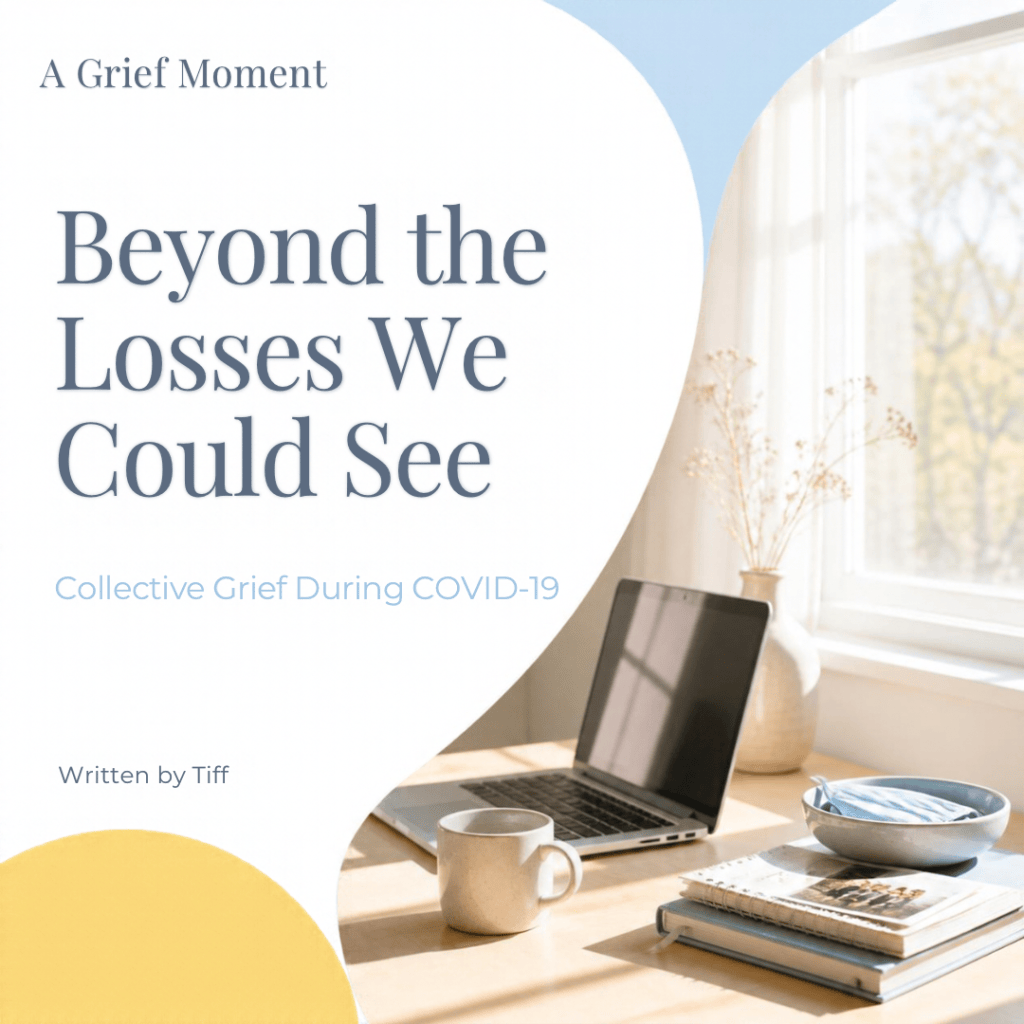
Written by Tiff | A Grief Moment
I want you to think back to the early days of COVID-19. Not just the sickness, the death tolls, or the images we saw on television. I want you to think about the little things. The things we did every day without thinking twice about them. The things that suddenly became complicated, uncomfortable, or even frightening.
Because COVID-19 did not just change how we lived. It changed how we interacted with one another, how safe we felt, how we worked, and how we understood the world around us.
I remember sitting in the call center where I worked as a manager. We would listen to news coverage about the virus spreading through China and talk about it in passing. It was concerning, of course, but it still felt far away. It was something happening somewhere else.
Then, just like that, it was at our front door.
Before COVID-19, I had been advocating for my team to work remotely. The work they did could be performed from home, but our company was not set up to operate that way. Making remote work possible had become one of my missions as their manager. I wanted my team to have that flexibility, and I was working toward making it happen.
I just never imagined it would happen like that.
I remember coming into the office and hearing management discuss sending everyone home. There was no carefully planned transition, no clear roadmap for how we would continue operating. Employees were given two cardboard boxes, told to pack up their desks, and instructed to take their computers home.
And that was it.
We left the office without knowing exactly how we would manage the work, how long we would be gone, or what would happen next. Some teams were furloughed. People were worried about their jobs. Everyone was trying to hold on to whatever security they still had.
Think about that for a moment. One day, you have a workplace, a routine, a team, and a general idea of what tomorrow will look like. The next day, you are packing your life into two cardboard boxes and hoping the next decision made about your future does not leave you without a paycheck.
That is a loss, too.
Research on grief during COVID-19 has documented how the pandemic created multiple layers of loss, including disrupted routines, employment changes, separation from loved ones, and the loss of the life people previously understood as normal (Kumar, 2023; Sirrine et al., 2023; Statz et al., 2023; Scheinfeld et al., 2022). Not every one of those experiences is grief for every person. But for many, the uncertainty and disruption carried a real emotional weight.
And the changes did not stop at work.
I remember sitting in a doctor’s office where everyone was quiet. An elderly woman dropped the contents of her bag, and my first instinct was to help her. That is what many of us have done our whole lives. Someone drops something, you help pick it up. Someone needs a hand, you offer one.
But I remember the looks, the hesitation, the awareness of everyone around us. Something as ordinary as helping another person had become complicated by the fear of getting too close.
We were trying to protect ourselves and one another. The virus was a real danger, and keeping our distance had a purpose. But that did not make the experience of distance any less strange.
Shaking hands, hugging, holding a door, stopping to talk, or standing close to someone in a checkout line suddenly required a different kind of thought. We began paying attention to how close we stood, what we touched, and who we might expose. Even the smallest interactions carried a question that had not been there before: Is this safe?
Research examining social relationships during lockdown found that distancing measures affected connections with partners, household members, neighbors, and communities. Some people experienced disconnection and loneliness, while others found new ways to support one another and experienced a greater sense of solidarity (Ferreira et al., 2023; Schneiders et al., 2022).
That contrast matters. We did not all experience the pandemic in the same way. But many of us had to relearn how to be around one another.
I remember going to Publix and finding restrictions on how much bread we could buy. One item per customer. I had to choose between hamburger buns and hot dog buns. Something so ordinary, something I would never have thought twice about before, suddenly required a decision because I could not simply buy both.
I remember telling people to meet me at the door. Leave the package outside. I would get it from there. We stayed inside. We avoided unnecessary contact. We worried about getting sick, and we worried about passing the virus to someone more vulnerable than ourselves.
The world had become a place where we had to think differently about everyday life.
And then there was the news.
We watched the reports of infections and deaths. We listened for updates. We tried to understand what was happening and what it meant for us and our families. The situation was serious, and we needed reliable information. But research during the pandemic also found associations between greater media exposure, fear and worry about COVID-19, and psychological distress (Mahat-Shamir et al., 2023; Sasaki et al., 2020; Stainback et al., 2020).
For many of us, it was difficult to look away from something that might affect whether we stayed healthy, kept our jobs, or could safely see the people we loved.
We were trying to make sense of an uncertain world while watching that uncertainty unfold in real time.
This is where I want us to think about collective grief.
When we hear the word grief, we often think about the death of someone we love. And that grief deserves to be recognized in its own right. But grief during COVID-19 was not limited to bereavement. Research has explored how people also experienced losses involving relationships, routines, normalcy, security, and their expectations for the future (Fang & Comery, 2021; Kumar, 2023).
Collective grief can help us understand what happens when people experience disruption and loss within the same broader event or social moment. It does not mean that everybody grieves in the same way, or that everyone experienced the same losses. It means that our individual experiences can unfold within a shared reality that changes life for many people at once.
Consider the loss of the casual conversations that once happened without planning. The comfort of visiting family without calculating risk. The ability to show up for someone in person. The familiar rhythm of going to work, shopping for groceries, or helping a stranger without first wondering whether closeness might put someone in danger.
Even when we were connected through phones and video calls, digital contact could not always replace being physically present. Studies of loneliness and social isolation during COVID-19 describe how the loss of in-person contact and ordinary interactions affected people’s experiences of connection (Klinenberg & Leigh, 2024; McKenna-Plumley et al., 2021).
We lost more than access to places. For a time, we lost some of the ease with which we occupied those places together.
And when we talk about grief, I think we need to make room for that.
We need to make room for the employee who feared losing their job. The parent who could not give their child the experiences they had imagined. The person who lived alone and missed the presence of another human being. The older adult who worried about exposure. The manager trying to keep a team functioning without knowing what the next week would bring. The person who missed a hug, a familiar routine, or simply feeling safe in an ordinary public space.
Studies of pandemic-related loss have described how these experiences could accumulate, affecting people’s sense of control and their ability to make sense of what was happening (Scheinfeld et al., 2022; Sirrine et al., 2023; Statz et al., 2023).
Not every disruption becomes grief. Not every person experienced the pandemic as a loss. And we should never assume that we know what someone else was carrying simply because we lived through the same period.
But we can acknowledge that the pandemic changed more than our schedules. It changed the conditions under which we worked, connected, cared for one another, and imagined the future.
I think back to those two cardboard boxes. I had spent time advocating for remote work, and suddenly, remote work was no longer a goal to work toward. It was the immediate reality. The change I had wanted for my team arrived in a way none of us could have planned for, surrounded by uncertainty about jobs, operations, and what would come next.
That memory reminds me that change can bring relief and fear at the same time. We can be grateful for an opportunity and still grieve the circumstances that forced it upon us. We can understand why distance was necessary and still miss the comfort of being close. We can survive a period of uncertainty and still carry memories of how unsettled the world felt.
So I want to ask you something.
When you think back to COVID-19, what do you remember losing that you did not recognize as a loss at the time?
Was it the freedom to move through the world without fear? The routine of going to work? The ability to reach out and help someone without hesitation? The comfort of being around people? Or the feeling that tomorrow would look somewhat like today?
Maybe your loss was much more personal. Maybe it was something no one else could see.
Whatever comes to mind, I hope we can make room for those memories without comparing whose experience was harder or deciding whose loss mattered more.
Because the pandemic was not one experience. It was millions of individual experiences unfolding inside one shared crisis.
And sometimes, the things we grieve are not only the people we lost. Sometimes, we grieve the life we knew, the connections we took for granted, and the sense of certainty we once carried without even realizing it.
Sometimes, we do not recognize what we have lost until the world asks us to live without it.
References
Fang, C., & Comery, A. (2021). Understanding grief during the first-wave of COVID-19 in the United Kingdom: A hypothetical approach to challenges and support. Frontiers in Sociology, 6, Article 607645. https://doi.org/10.3389/fsoc.2021.607645
Ferreira, J. M., Merçon-Vargas, E. A., & Midgette, A. J. (2023). Sociability, social isolation, and social interaction during the first months of COVID-19 pandemic: A qualitative analysis of Brazilian, Finnish, and American adults. Trends in Psychology, 31, 924–956. https://doi.org/10.1007/s43076-022-00172-9
Klinenberg, E., & Leigh, J. K. (2024). On our own: Social distance, physical loneliness, and structural isolation in the COVID-19 pandemic. Social Problems, 71(4), 1216–1230. https://doi.org/10.1093/socpro/spad003
Kumar, R. M. (2023). The many faces of grief: A systematic literature review of grief during the COVID-19 pandemic. Illness, Crisis & Loss, 31(1), 100–119. https://doi.org/10.1177/10541373211038084
Mahat-Shamir, M., Pitcho-Prelorentzos, S., Kagan, M., Kestler-Peleg, M., & Lavenda, O. (2023). Adjustment disorder in the face of COVID-19 outbreak: The impact of death anxiety, media exposure, fear of contagion and hypochondriasis symptoms. OMEGA—Journal of Death and Dying, 87(4), 1189–1206. https://doi.org/10.1177/00302228211034372
McKenna-Plumley, P. E., Graham-Wisener, L., Berry, E., & Groarke, J. M. (2021). Connection, constraint, and coping: A qualitative study of experiences of loneliness during the COVID-19 lockdown in the UK. PLOS ONE, 16(10), e0258344. https://doi.org/10.1371/journal.pone.0258344
Sasaki, N., Kuroda, R., Tsuno, K., & Kawakami, N. (2020). Exposure to media and fear and worry about COVID-19. Psychiatry and Clinical Neurosciences, 74(9), 501–502. https://doi.org/10.1111/pcn.13095
Scheinfeld, E., Gangi, K., Nelson, E. C., & Sinardi, C. C. (2022). Please scream inside your heart: Compounded loss and coping during the COVID-19 pandemic. Health Communication, 37(10), 1316–1328. https://doi.org/10.1080/10410236.2021.1886413
Schneiders, M. L., Mackworth-Young, C. R. S., & Cheah, P. Y. (2022). Between division and connection: A qualitative study of the impact of COVID-19 restrictions on social relationships in the United Kingdom. Wellcome Open Research, 7, Article 6. https://doi.org/10.12688/wellcomeopenres.17452.1
Sirrine, E. H., Kliner, O., & Gollery, T. J. (2023). College student experiences of grief and loss amid the COVID-19 global pandemic. OMEGA—Journal of Death and Dying, 87(3), 745–764. https://doi.org/10.1177/00302228211027461
Stainback, K., Hearne, B. N., & Trieu, M. M. (2020). COVID-19 and the 24/7 news cycle: Does COVID-19 news exposure affect mental health? Socius, 6. https://doi.org/10.1177/2378023120969339
Statz, T. L., Kobayashi, L. C., & Finlay, J. M. (2023). Losing the illusion of control and predictability of life: Experiences of grief and loss among ageing U.S. adults during the COVID-19 pandemic. Ageing & Society, 43(12), 2821–2844. https://doi.org/10.1017/S0144686X21001872